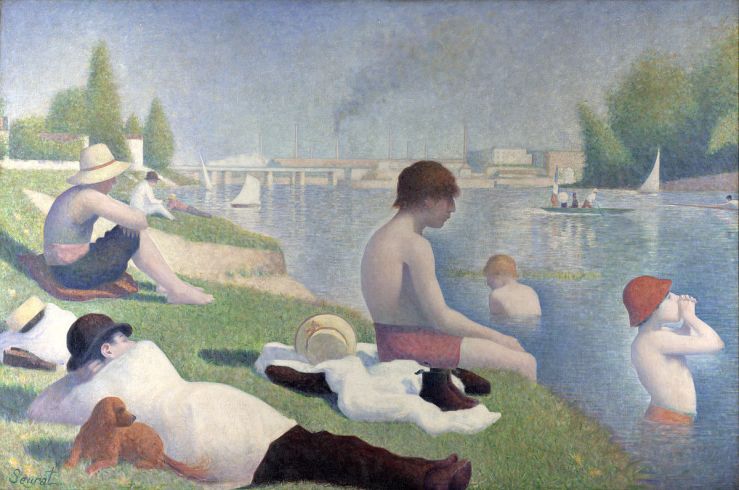
“The whole of Seurat’s life was a slow, stubborn, tireless, and fanatic preparation to reach the formal perfection he achieved in his two masterworks.
In Bathers at Asnières, that perfection astonishes, and in a way, overwhelms us: the repose of the figures sunning themselves, bathing in the river, or contemplating the scenery, beneath a midday sun that seems to dissolve the distant bridge, the locomotive crossing it, and the chimneys of Passy into the dazzle of a mirage. This tranquility, this balance, and this secret harmony between man and water, cloud and sailboat, costume and oars are certainly manifestations of a total command of the medium, the sureness of line, and the use of color, all achieved by dint of effort; but they also represent an elevated and noble conception of the art of painting as a means of spiritual fulfillment and a source of pleasure in and of itself, in which painting is understood as its own best reward, a métier in the practice of which one finds meaning and joy.”
Mario Vargas Llosa, from The Language of Passion
 Notes on Wonder